

A story about a company at a crossroads — and the decision that changed everything.
Arun had built his company from a spare bedroom into a 60-person operation with INR 70 Crores in annual revenue. He was proud of what he’d done, but he knew he’d hit a ceiling. His go-to-market strategy was a patchwork of instincts and half-finished experiments. His sales team was talented but directionless. He needed a leader — a real one — to take them to the next level.
SoArun did what any growth-minded founder does. He opened a job requisition for a Chief Revenue Officer.
What he didn’t expect was to be choosing between two entirely different philosophies of leadership.
Candidate One: The Promising Climber
Her name was Priya. Thirty-eight years old, sharp as a tack, with 12 years of experience across two SaaS companies and a fintech startup. Her résumé was clean and compelling. She’d managed teams of up to 20, helped one company scale from INR 50 Cr to INR 130Cr ARR, and had the energy of someone who still had something to prove.
Arun liked her immediately.
The offer came together quickly — a base salary of 1.2 Cr. equity, benefits, and the promise of building something great together. Priya accepted. She gave 30 days’ notice to her current employer and joined Arun’s company on a crisp Monday in October.
For the first three months, things were good. Priya was learning the business, running 1:1s, rewriting the sales playbook. She was thoughtful and methodical.
But by month four, something was becoming clear. The problems Priya was encountering — channel conflict, enterprise pricing strategy, a stalled partnership pipeline — were problems she hadn’t personally solved before. She’d seen them, from a distance, at a previous company. But she’d never held the wheel through the storm.
She was learning on the job. And Arun was paying full price for the education.
Candidate Two: The One Who’d Already Seen the Movie
Around the same time Arun was posting his job listing, a mutual connection suggested he have a conversation with someone named VinodMalhotra.
Vinod was 54. He’d spent 25 years in revenue leadership — VP of Sales at a Series B cybersecurity firm, CRO at two PE-backed software companies, and an advisor to a handful of early-stage start-ups. He’d led teams through acquisitions, through market downturns, through rapid international expansion. He’d made the mistakes, paid for them, and built scar tissue that no business school program could replicate.
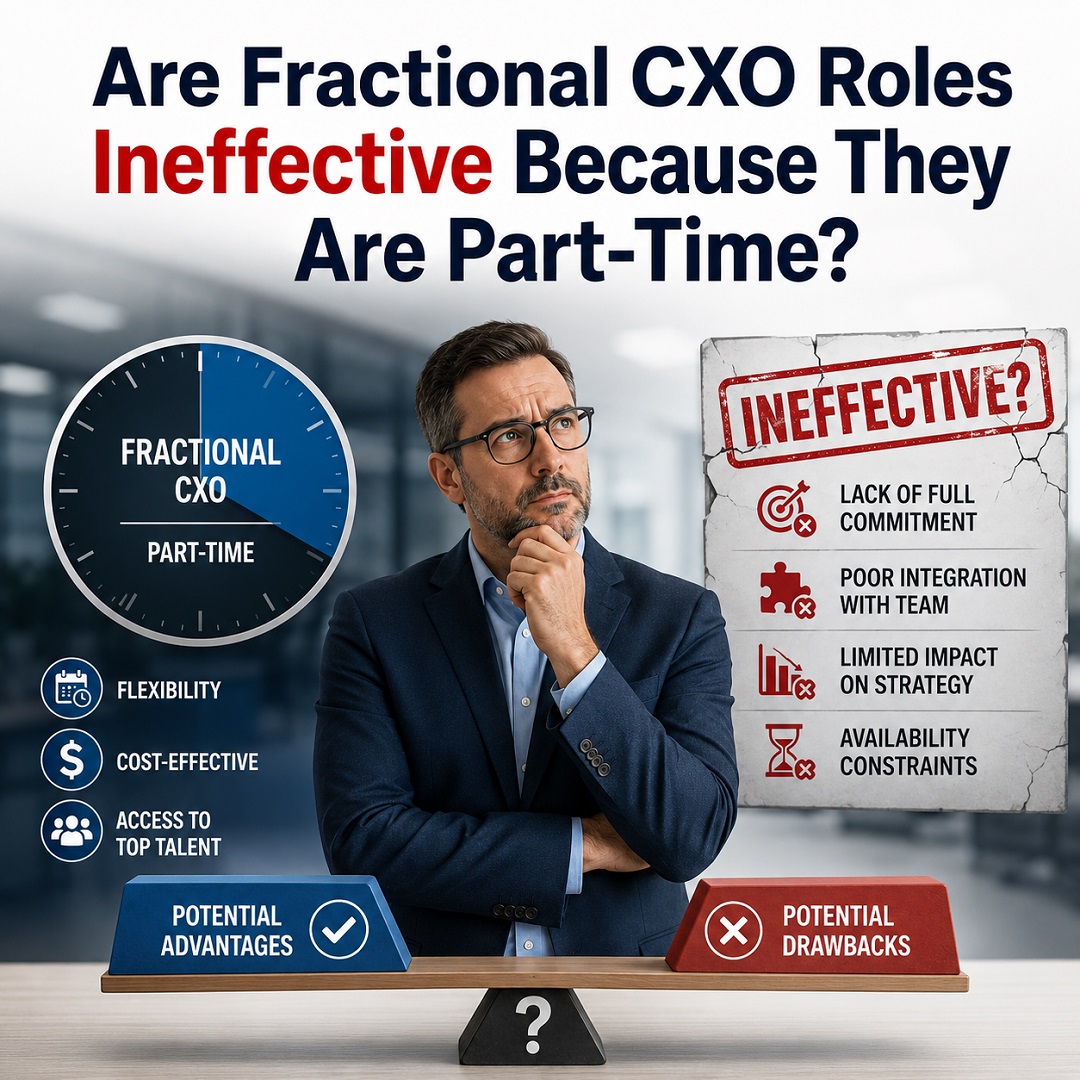
Vinod wasn’t looking for a full-time role. He operated as a fractional CRO, working with two or three companies at a time, typically two to three days a week each.
Arun almost dismissed the idea. Fractional? It sounded like a compromise — like hiring a part-time babysitter to run a Fortune 500 household.
But he took the meeting. And something Vinod said stopped him cold:
“You don’t need someone who’s going to spend their first year figuring out what questions to ask. You need someone who walked in the door already knowing the answers.”
The Numbers That Changed Arun’s Mind
When Arun sat down and ran the real math, the picture shifted.
Priya’s full-time package — salary, equity, benefits, payroll taxes, recruiting fees — landed north of INR 1.5 Cr in total annual cost. And that was before accounting for the six-to-twelve-month ramp time during which a new full-time executive is still orienting, still building trust, still learning the quirks of the business.
Vinod’s fractional arrangement came in at INR 5,00,000 a month — roughly INR 60,00,000 annually — for a dedicated, high-output engagement. No equity dilution. No recruiting fees. No benefits overhead. And he could start making meaningful contributions in week two, not month six.
But cost was only part of the equation.
Experience Isn’t Linear — It Compounds
There’s a particular kind of wisdom that only comes from having been burned.
Priya knew the theory of enterprise sales cycles. Vinod had personally navigated 40 of them — including three that collapsed at the final legal review and taught him exactly why, and how to prevent it.
Priya had read about channel partner programs. Vinod had built three from scratch, killed one that wasn’t working, and rebuilt it better.
When Arun’s sales team brought a pricing dilemma to Priya, she scheduled a strategy session. When they brought the same kind of problem to Vinod, he said, “I’ve seen this exact scenario twice. Here’s what worked, here’s what didn’t, and here’s what I’d do.”
The team didn’t just get a decision. They got a lesson.
That’s the compounding power of 25 years. It’s not just more experience — it’s categorically different experience. The kind that has survived contact with reality, over and over again, across industries, cycles, and company stages.
The Hidden Gift: Perspective Without Ego
One of the unexpected advantages Arun discovered with Vinod was something harder to quantify: detachment.
Priya, as a full-time CRO, had her identity bound up in the role. Her career trajectory, her equity upside, her internal political capital — all of it was tied to the company’s outcomes in ways that could, subtly, distort her judgment. She wanted to be seen as indispensable. She wanted to build a large team. She wanted the next promotion.
Vinod, operating fractionally, had none of those incentives. He wasn’t angling for a seat at the board table. He wasn’t building an empire. He came in, did the work, and told Arun exactly what he thought — including the uncomfortable things, like when Arun himself was the bottleneck. That kind of fearless honesty, unclouded by internal politics, turned out to be one of the most valuable things Arun hadn’t known he was missing.
Flexibility as a Feature, not a Compromise
Six months into the engagement, Arun’s business hit an unexpected inflection point — a large enterprise prospect that could triple their ARR in a single deal. It required Vinod to go deep for three weeks, essentially full-time, on deal strategy, executive alignment, and pricing negotiation.
Then, after the deal closed, the intensity naturally dialled back.
That elasticity — the ability to flex up and down with the actual rhythm of the business — was something a full-time hire simply couldn’t offer. With Priya, Arun would have been paying the same fixed cost whether the company needed maximum horsepower or just steady maintenance. With Vinod, the engagement breathed with the business.
When Full-Time Is the Right Answer
To his credit, Arun didn’t walk away from this story thinking fractional is always the answer. It isn’t.
There are moments when a company needs a full-time operator embedded in the culture, available at midnight, attending every all-hands, building the institutional muscle over years. When you’re hiring someone to eventually become CEO. When you need someone, whose entire professional identity is fused with the mission.
And Priya, wherever she went next, would become a Vinod someday. She just wasn’t there yet.
But for a company in growth mode — one that needs battle-tested judgment delivered efficiently, without the overhead of a full executive hire — the fractional leader is one of the most underutilized assets in the market.
The Lesson Arun Learned
A year after bringing Vinod on, Arun’s sales team had a repeatable enterprise motion, a functioning partner program, and a pipeline three times the size it had been. Vinod had helped hire Priya’s eventual successor — a full-time VP of Sales who could execute the strategy Vinod had architected.
Then Vinod transitioned out, as planned, and moved on to his next engagement.
Arun told the story at a founder dinner recently. Someone asked him what he’d do differently if he was starting over.
He smiled. “I’d stop thinking ‘fractional’ means less. Sometimes it means more — just delivered smarter.”