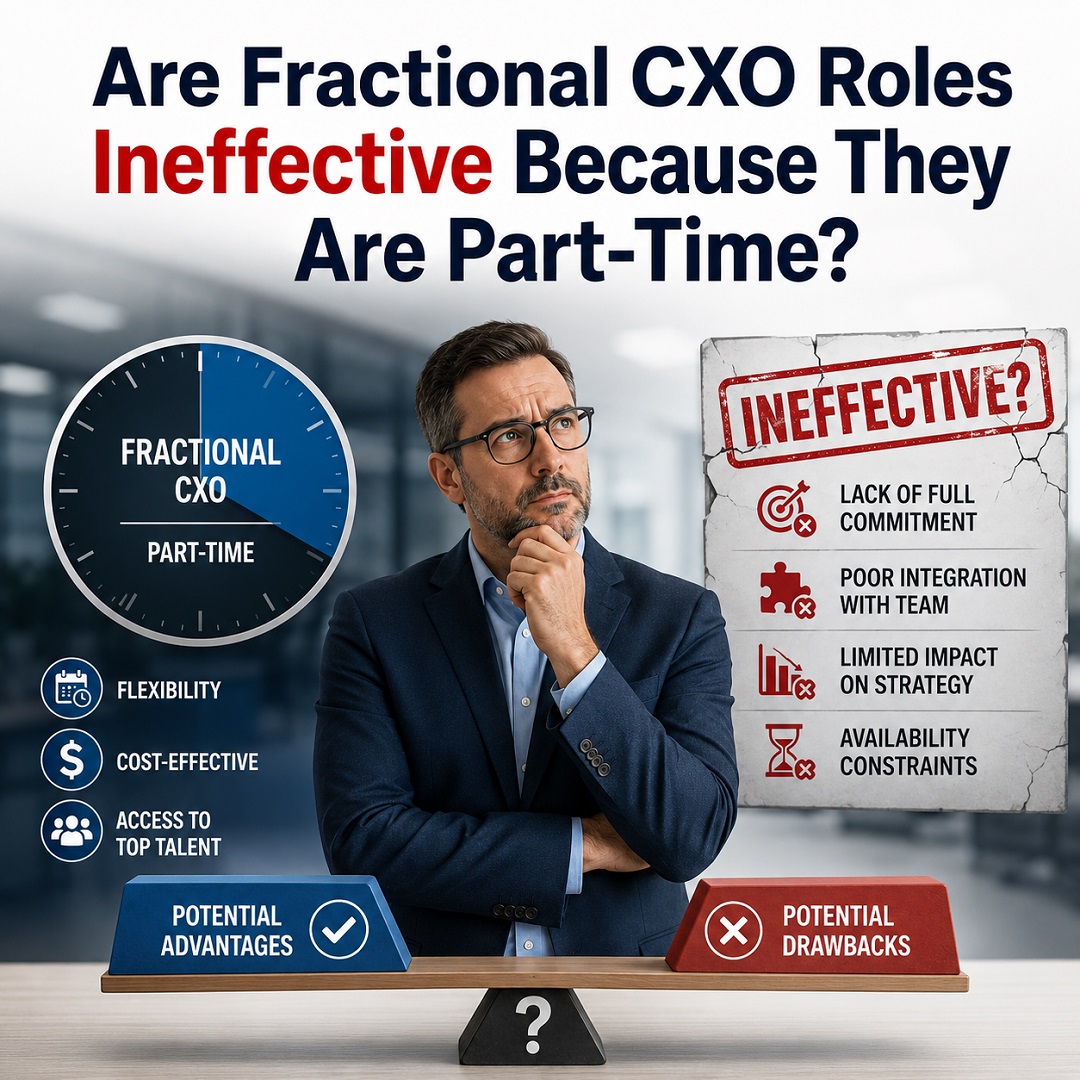


Why India’s growth-stage companies are rethinking the C-suite — and saving crores in the process
There’s a quiet revolution happening in boardrooms across Bengaluru, Mumbai, and Gurugram. Founders who once believed that building a serious company meant filling every leadership seat with a full-time executive are discovering a sharper, leaner truth: you don’t need to own the whole car to get where you’re going.
Fractional leadership — hiring seasoned C-suite and senior professionals for a defined portion of their time — is no longer a compromise. For the right organisation at the right stage, it is the most intelligent deployment of capital available.
The Full-Time Executive Illusion
Let’s start with an honest number. A competent, experienced Chief Marketing Officer in India — someone with 15+ years of track record, credibility with investors, and the strategic range to actually move the needle — commands a total cost-to-company (CTC) of anywhere between ₹80 lakh and ₹2 crore per annum, depending on the city and sector. Add ESOPs, performance bonuses, a team to manage, tools, travel, and the cost of a wrong hire, and you are looking at a multiyear commitment that can easily cross ₹5–6 crore before you see meaningful returns.
For a Series A start-up generating ₹10–30 crore in annual revenue, that is not a hire. That is a bet.
The same arithmetic applies across functions. A full-time CFO costs ₹60 lakh to ₹1.5 crore annually. A Chief Human Resources Officer with the depth to design culture and hire at scale runs ₹50 lakh to ₹1.2 crore. A Chief Technology Officer who can actually architect systems and lead engineer’s command ₹1 crore to ₹2.5 crore or more.
For a company that needs strategic leadership across three or four functions, the bill for a full executive bench easily exceeds ₹4–7 crore per year — before a single product is shipped or a single customer is acquired.
What Fractional Leadership Actually Costs
A fractional executive typically engages for two to three days per week, or on a defined monthly retainer structured around outcomes rather than presence. The market rate in India for fractional C-suite talent sits broadly in this range:
| Role | Full-Time CTC (Annual) | Fractional Engagement (Annual) | Saving |
| Chief Marketing Officer | ₹80L – ₹2Cr | ₹18L – ₹40L | ~65–75% |
| Chief Financial Officer | ₹60L – ₹1.5Cr | ₹15L – ₹35L | ~65–75% |
| Chief Human Resources Officer | ₹50L – ₹1.2Cr | ₹12L – ₹30L | ~60–70% |
| Chief Technology Officer | ₹1Cr – ₹2.5Cr | ₹24L – ₹55L | ~60–75% |
| Chief Revenue Officer | ₹90L – ₹2Cr | ₹20L – ₹45L | ~65–75% |
These are not approximations meant to flatter the model. They are reflective of an active and growing market of senior professionals — many of them ex-founders, ex-MNC leaders, or early employees of scaled companies — who have chosen portfolio careers over single-employer commitments.
A company that engages a fractional CMO, CFO, and CHRO simultaneously might spend ₹55–90 lakh per year for all three. The equivalent full-time bench would cost ₹1.9–4.7 crore. The difference — conservatively ₹1.3–3.8 crore annually — can fund a product team, a sales force, or eighteen months of runway.
Value Is Not Discounted Just Because Time Is
The critical misunderstanding about fractional leaders is the assumption that less time means less value. This confuses availability with contribution.
A fractional CMO who has scaled three direct-to-consumer brands from ₹5 crore to ₹100 crore in revenue does not need six months to understand your funnel. They arrive with pattern recognition that a first-time full-time hire is still building. The learning curve — which routinely costs organisations ₹20–40 lakh in lost productivity in the first year of a senior hire — is dramatically compressed.
What fractional leaders bring is concentrated expertise without the dilution of internal politics, comfort-seeking, or empire-building. They are engaged for outcomes. They know it. You know it. That alignment changes the quality of every conversation.
Consider a Series B fintech that recently hired a fractional CFO for two days per week at ₹28 lakh per year. Within four months, she had restructured the company’s vendor payment terms, reducing working capital requirements by ₹1.8 crore, renegotiated a banking facility that saved ₹22 lakh annually in interest costs, and prepared the financial narrative that secured the company’s next funding round. Total cost to company: ₹28 lakh. Measurable financial impact in year one: north of ₹2 crore. That is not a good hire. That is an exceptional return on capital.
The Hidden Costs That Fractional Eliminates
When evaluating a full-time hire versus a fractional engagement, most founders compare salaries. They should compare total costs.
Recruitment: A retained search for a senior executive typically costs ₹8–20 lakh in placement fees. Add internal time, multiple interview rounds, and reference checks, and the true cost of finding and selecting a full-time C-suite hire often exceeds ₹25 lakh before the person joins.
Onboarding and ramp time: Senior leaders in unfamiliar organisations typically operate at 40–60% effectiveness for the first three to six months. On a ₹1 crore salary, that is ₹20–40 lakh of paid-for output that is not yet arriving.
Benefits, compliance, and administration: Provident Fund, gratuity, health insurance, leave encashment, and HR administration for a senior employee add roughly 10–15% to the CTC — often ₹8–20 lakh per year for a leader in this bracket.
Severance and exit cost: If the hire does not work out — and research consistently shows that 30–40% of senior hires underperform — the cost of managing an exit, serving notice periods, and restarting the search can add another ₹20–50 lakh in direct and indirect costs.
Fractional engagements carry none of these burdens at the same scale. Most are structured with 30–60 day exit clauses. There is no recruitment fee, no ramp-time tax, and no severance liability.
When Fractional Leadership Makes the Most Sense
Fractional is not for every organisation or every function. It earns its highest returns in specific, identifiable situations.
Scale-up stage, not start-up chaos: A fractional leader performs best when there is enough organisational structure for them to plug into. A ten-person pre-revenue team may need a founder who is also the CMO. A 50–200-person organisation generating ₹15–100 crore in revenue, navigating its next stage of growth, is precisely where fractional leadership creates asymmetric value.
Functions that need strategy more than presence: Not every leadership role requires a full-time body in a chair. The CFO function, for instance, is often best served by a deeply experienced fractional leader supported by a strong finance manager and a controller. The strategic layer — investor relations, financial planning, fundraising readiness — demands expertise, not hours.
During transition and transformation: When a company is between permanent hires, entering a new market, preparing for a fundraise, or restructuring a team, a fractional leader can provide continuity and direction without the commitment of a permanent appointment. This is leadership-as-infrastructure, exactly when it is needed.
When the expertise is rare: India has perhaps a few hundred professionals who have genuinely led B2B SaaS revenue at scale, or who have taken a consumer brand through a hyperscale phase. Many of them are now fractional. A company that could never afford their full-time attention can access their judgment for two days a week at a fraction of the cost.
The Multiplier Effect on the Rest of the Organisation
One often overlooked dimension of fractional leadership is its impact on the teams below.
A great fractional CMO does not just run marketing strategy. They mentor the in-house marketing manager who, for the first time, has access to someone who has seen what good looks like. They bring frameworks, vendor networks, agency relationships, and hiring standards that the organisation would otherwise spend years building through trial and error.
In this sense, the fractional leader functions as an accelerant — compressing organisational learning in a way that compounds well beyond their direct contribution. The ₹25 lakh spent on a fractional CHRO who installs a structured performance review process, builds a hiring rubric, and reduces attrition by 15% has paid for itself many times over in retained talent and avoided rehiring costs, which in India average ₹3–8 lakh per mid-level employee when you factor in recruitment, onboarding, and productivity loss.
Objections, Honestly Addressed
“They won’t be committed.” The fractional professionals building reputations in this space are deeply invested in outcomes — their next engagement depends on this one’s success. The incentive structure often produces more accountability, not less.
“They won’t understand our culture.” Culture fit matters. But it is evaluated and developed through working together, not through a full-time offer letter. Many fractional leaders describe stronger working relationships precisely because the engagement is voluntary on both sides.
“We need someone full-time eventually.” True. And a fractional engagement is often the best extended interview a company can run. Several organisations have converted their fractional CMO or CFO into a full-time leader after 12–18 months, with near-zero risk of a hiring mistake and a team that has already been built.
The Shift in How Serious Companies Think About Talent
The fractional model is not a workaround for organisations that cannot afford leadership. It is a deliberate architecture choice by organisations that have decided to deploy capital where it compounds fastest.
Global companies like Unilever, Nestlé, and several marquee PE-backed firms have used fractional and interim executives for decades. In India, the model is maturing rapidly, driven by a generation of senior leaders who value portfolio careers and by founders who have learned — sometimes expensively — that filling a seat is not the same as solving a problem.
For an organisation spending ₹10–30 crore on people annually, rethinking even two or three leadership positions through a fractional lens can free up ₹1–3 crore per year — capital that, deployed into product, sales, or technology, will return multiples.
The question is no longer whether fractional leadership works. The evidence is abundant. The question is whether your organisation is ready to measure leadership by value created rather than hours logged.
In a market where every rupee of capital is a bet on the future, that distinction matters more than ever.
The fractional leadership market in India is growing rapidly, with platforms, networks, and independent practitioners increasingly available across functions. For founders evaluating this model, the first step is simply asking: what does our organisation need at this stage — a seat filled, or a problem solved?