

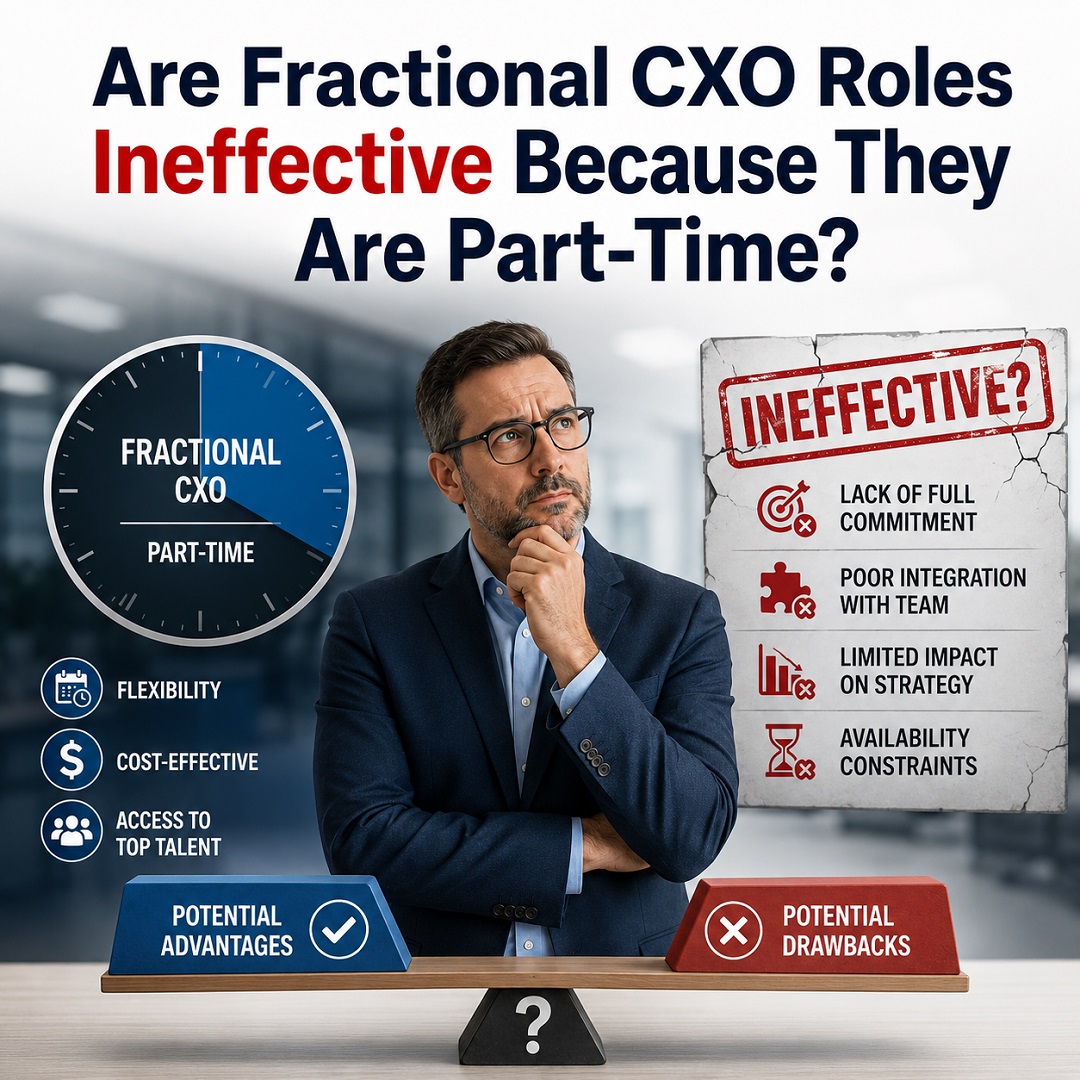
The most common objection to fractional leadership — and why the data, the logic, and the results tell a very different story
The Objection Sounds Reasonable. It Isn’t.
When companies first encounter the fractional CXO model, a predictable concern surfaces in the room: “But they’re only part-time. How can someone truly lead if they’re not here every day?”
It’s a fair question. Leadership is demanding. Businesses move fast. Decisions don’t wait for scheduled check-ins. How can someone who spends two or three days a week with your company possibly deliver what a full-time executive can?
The short answer: they often deliver more.
But the longer answer is more interesting — because it requires us to examine what we actually mean by effective leadership, and whether the hours-in-seat model of executive performance was ever the right way to measure it.
The Myth of the Omnipresent Executive
Let’s start with a question that rarely gets asked: what does a full-time C-suite executive actually do with their time?
The honest answer, backed by decades of management research, is: a lot of things that don’t directly move the needle.
Studies on executive time allocation consistently show that senior leaders spend a significant portion of their working week in routine status meetings, internal reporting cycles, inbox management, and organizational politics. A landmark Harvard Business School study tracking CEOs found that executives spend a large share of their time in meetings — many of which are informational rather than decisional, and many of which could be handled at lower levels of the organization.
The strategic work — the thinking, the positioning, the decisions that actually shape outcomes — often happens in a surprisingly small fraction of total working hours.
A fractional executive, by contrast, is engaged exclusively for that strategic layer. They are not attending your all-hands meeting about the new office plants. They are not sitting in on HR onboarding sessions. They are not cc’d on every internal thread. Their time with you is carved out for high-leverage work — and that changes the quality of their engagement dramatically.
Part-time hours. Full-time thinking.
What “Effective” Leadership Actually Requires
To evaluate whether fractional CXOs are effective, we first need to define what effectiveness looks like in executive leadership. It comes down to four things:
1. Strategic clarity — Does the executive understand the business deeply enough to make sound decisions?
2. Decision quality — Are the calls they make moving the company in the right direction?
3. Team leadership — Can they attract, develop, and align the people around them?
4. Accountability — Are they owning outcomes, not just inputs?
None of these four things are a function of hours worked per week. They are a function of experience, judgment, preparation, and commitment — all of which a skilled fractional executive brings in full. A CMO who has built and scaled three B2B SaaS go-to-market engines doesn’t need five days a week to diagnose why your pipeline is stalling. They’ve seen it before. They know what questions to ask. They know what the answer probably is before the analysis is even complete. Their value is in the quality of their thinking — not the quantity of their presence.
The Surgeon Analogy
Here’s a useful way to think about it.
When you need surgery, you don’t hire a surgeon to live in your house. You engage them for a specific, high-stakes intervention. You want the most experienced, skilled surgeon available — not the one who will spend the most hours with you. Presence is not the point. Expertise is.
A fractional CXO operates on the same principle. They are not a generalist employee filling a seat. They are a specialist engaged for high-value, high-impact work. The engagement is scoped, structured, and purposeful — which is precisely what makes it effective.
The analogy extends further: the best surgeons don’t just operate. They diagnose, they advise, they follow up. The best fractional executives don’t just show up for their allotted days — they remain reachable, they think about your business in between sessions, and they bring an ongoing commitment to the outcome, not just the calendar.
The Real Risks — And How to Manage Them
To be intellectually honest, the part-time nature of fractional work does create real challenges. Dismissing them would be misleading. But each one is manageable.
Challenge 1: Context Gaps
A fractional executive who is only present two days a week may miss the informal conversations, the hallway moments, the evolving team dynamics that full-time leaders absorb naturally.
The fix: Structured onboarding, clear communication rhythms, and a designated internal point of contact who keeps the fractional executive informed between sessions. Many fractional executives are also reachable asynchronously — via Slack, email, or WhatsApp — even on days they’re not formally engaged.
Challenge 2: Split Attention
A fractional CXO typically works with multiple companies simultaneously. Is their mind fully on your business when they’re sitting in another company’s strategy session?
The fix: This concern applies equally to any professional who has a life outside of work — and it ignores the enormous benefit of cross-company pattern recognition. Yes, they work with other companies. That’s why they’re so good. The same intelligence that helps Company A navigate a competitive threat will inform how they help Company B three weeks later. Their portfolio of engagements is a feature, not a bug.
Challenge 3: Cultural Integration
Leadership is partly relational. A fractional executive who isn’t embedded in the day-to-day culture may struggle to build the trust and influence that full-time leaders develop over time.
The fix: This is a genuine limitation in some cases — particularly for companies that require deep cultural stewardship over years. But for most growth-stage companies, the need is not deep cultural embedding; it’s sharp strategic direction and operational momentum. Fractional executives can absolutely build strong relationships and genuine trust within the scope of their engagement. Many do it repeatedly, across companies, as a core professional skill.
Challenge 4: Continuity Risk
What happens when the engagement ends or the fractional executive transitions out?
The fix: This is actually one of the fractional model’s strengths, not a weakness. The best fractional executives are intentional about knowledge transfer and building internal capability. They document decisions, develop internal leaders, and often help recruit their own full-time successors. Transitions are planned, not abrupt.
Where Part-Time Leadership Genuinely Doesn’t Work
Intellectual honesty requires acknowledging that fractional leadership is not universally appropriate.
There are situations where a full-time, deeply embedded executive is the right answer:
- Early-stage companies where the CXO role is also a culture-founding role. The first CMO or CTO at a 10-person startup may need to be a full-time culture carrier, not just a strategic advisor.
- Crisis situations requiring round-the-clock commitment. A company in existential distress — battling a PR crisis, navigating regulatory action, managing a hostile takeover — may need a leader available at any hour for an extended period.
- Roles that are primarily operational at scale. A COO managing 500 people across four geographies may simply need to be present in ways that a fractional arrangement can’t accommodate.
- Companies that need a visible, external-facing leader. A CFO who is regularly presenting to public market investors, or a CEO who is the public face of the brand, may need a permanence that fractional doesn’t provide.
These are real constraints. But they describe a minority of situations — particularly in the startup, SME, and growth-stage company universe where fractional leadership thrives.
The Evidence: What Results Actually Show
The strongest argument against the “part-time equals ineffective” thesis is simply this: the results.
Fractional CFOs have helped companies close funding rounds, clean up balance sheets, and navigate regulatory scrutiny — on part-time engagements. Fractional CMOs have repositioned brands, built pipeline engines, and driven double-digit growth — two or three days a week. Fractional CTOs have architected platforms, built engineering teams, and shipped products — without sitting at a desk five days a week.
The companies that have embraced fractional leadership — and there are thousands of them, from early-stage startups to established SMEs — are not reporting that their executives are ineffective. They are reporting faster time-to-impact, lower cost, and access to expertise they couldn’t otherwise afford.
The market is the verdict. Fractional leadership is growing because it works.
Reframing the Question
Perhaps the most useful shift is to stop asking “Is part-time enough?” and start asking “Enough for what?”
If the answer is: enough to fill a seat, attend every meeting, and be visibly present at all times — then no, part-time is not enough. But that was never the job.
If the answer is: enough to provide strategic direction, make high-quality decisions, develop the team, and drive the outcomes the business needs — then yes, absolutely. For the right executive, in the right engagement, part-time is not a limitation. It’s a design.
The fractional model doesn’t ask executives to do less. It asks them to do what matters most — and to do it with the full weight of their experience, their judgment, and their accountability.
The Bottom Line
The assumption that part-time equals ineffective is rooted in an industrial-era model of work — where value was measured in hours, presence was a proxy for performance, and expertise was assumed to be proportional to time spent.
That model was always a poor fit for executive leadership. And in an era of distributed work, accelerating business cycles, and increasingly specialized knowledge, it’s become even less relevant.
The fractional CXO isn’t a half-measure. They are a precise measure — calibrated for the exact strategic need of a company at a specific stage of its growth.
The question was never whether part-time leadership can be effective.
The question is whether you’re working with the right person — and whether you’re structured to make the most of what they bring.
Get those two things right, and the number of days on the calendar becomes almost irrelevant.
Effectiveness in leadership has never been about hours. It has always been about judgment, experience, and the courage to make the right call. Fractional CXOs bring all three — in exactly the dose your business needs.